
The UK Retail App Search Wars
A whitepaper on Apple Ads visibility, shopper intent, and retail app growth in the UK App Store, based on APPlyzer analysis of generic (non-brand) retail searches.
Executive summary
Retail app discovery in the UK App Store is not built around the phrase “retail app”. Users search by intent: shop, shopping, online shopping, clothes shopping, grocery delivery, furniture, deals, sneakers, perfume, used clothes.
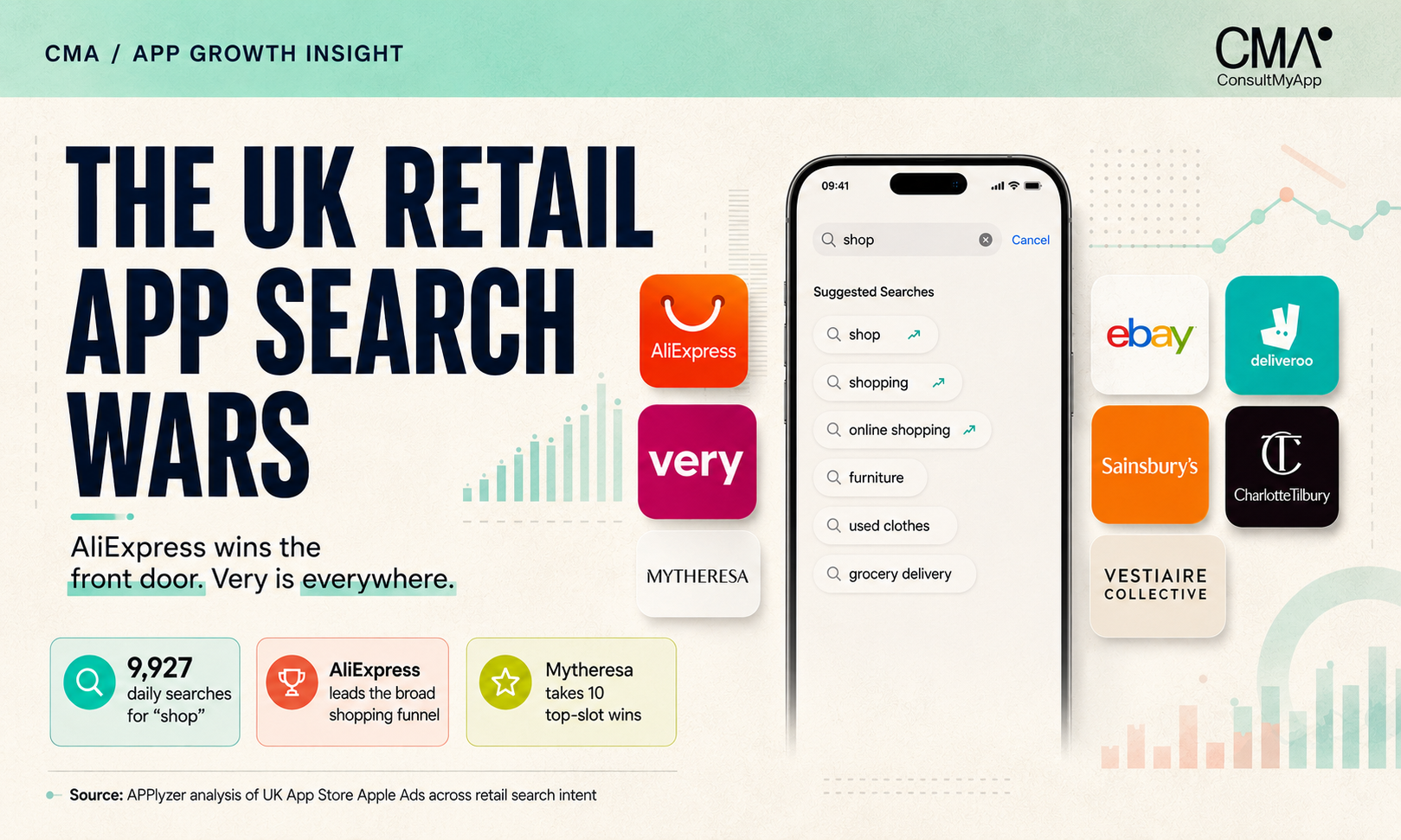
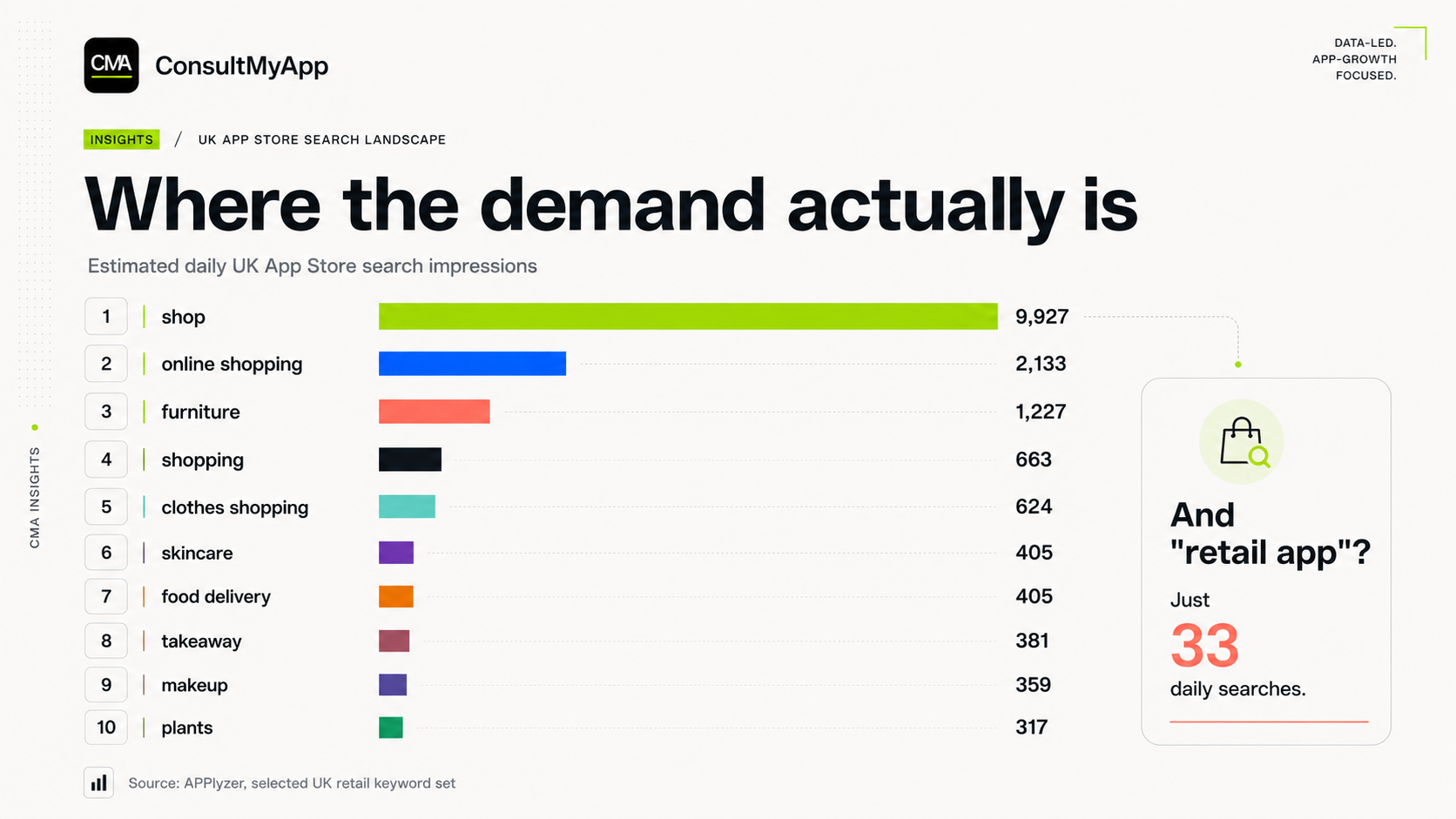
In APPlyzer’s UK App Store data, “retail app” showed 33 estimated daily searches, while “shop” showed 9,927. That gap alone changes how retail brands should think about Apple Ads.
Core conclusion
Retail Apple Ads is not a category game. It is an intent game.
What the data suggests
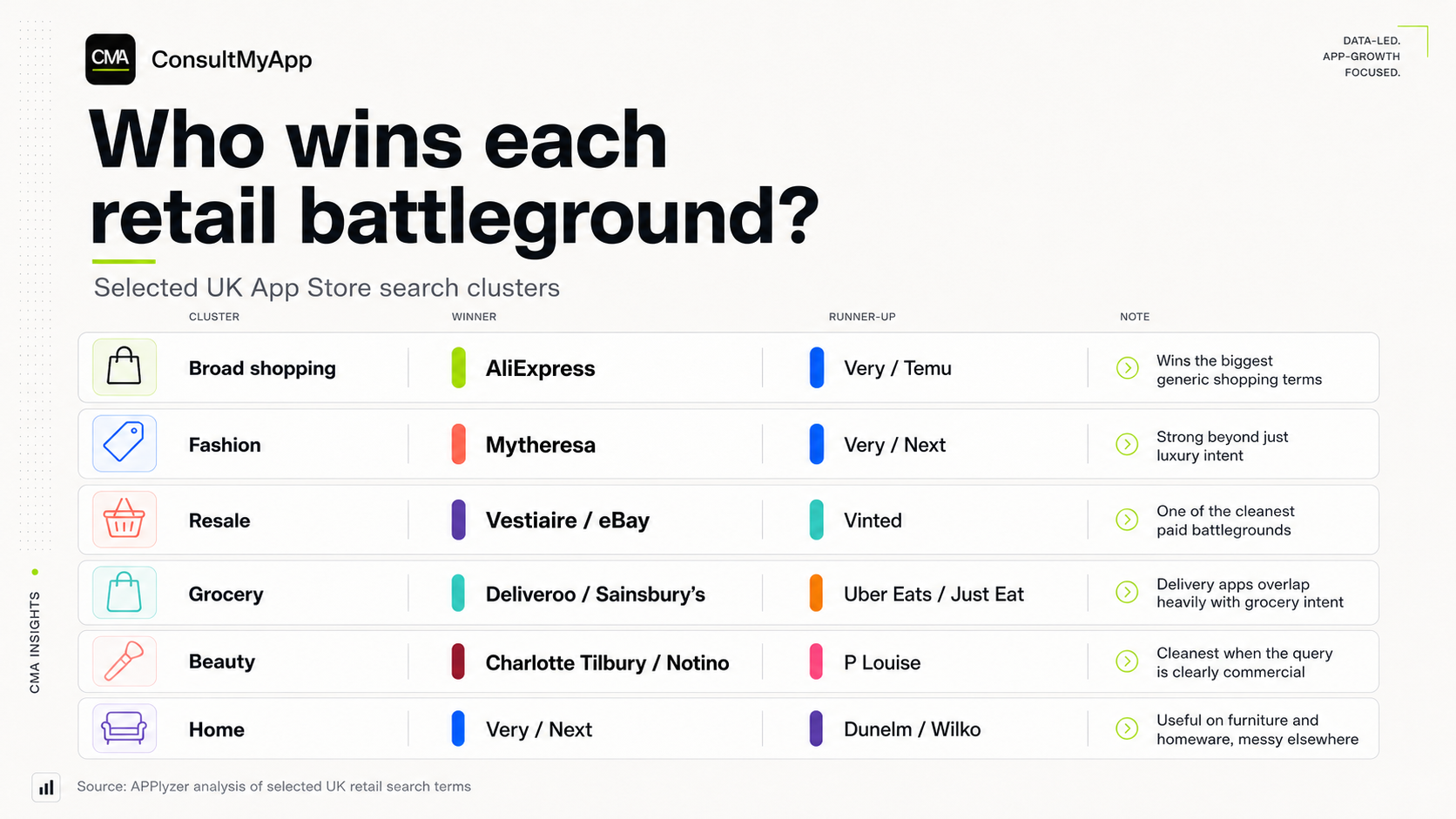
- AliExpress dominates broad shopping intent.
- Very shows up across the widest spread of retail intent.
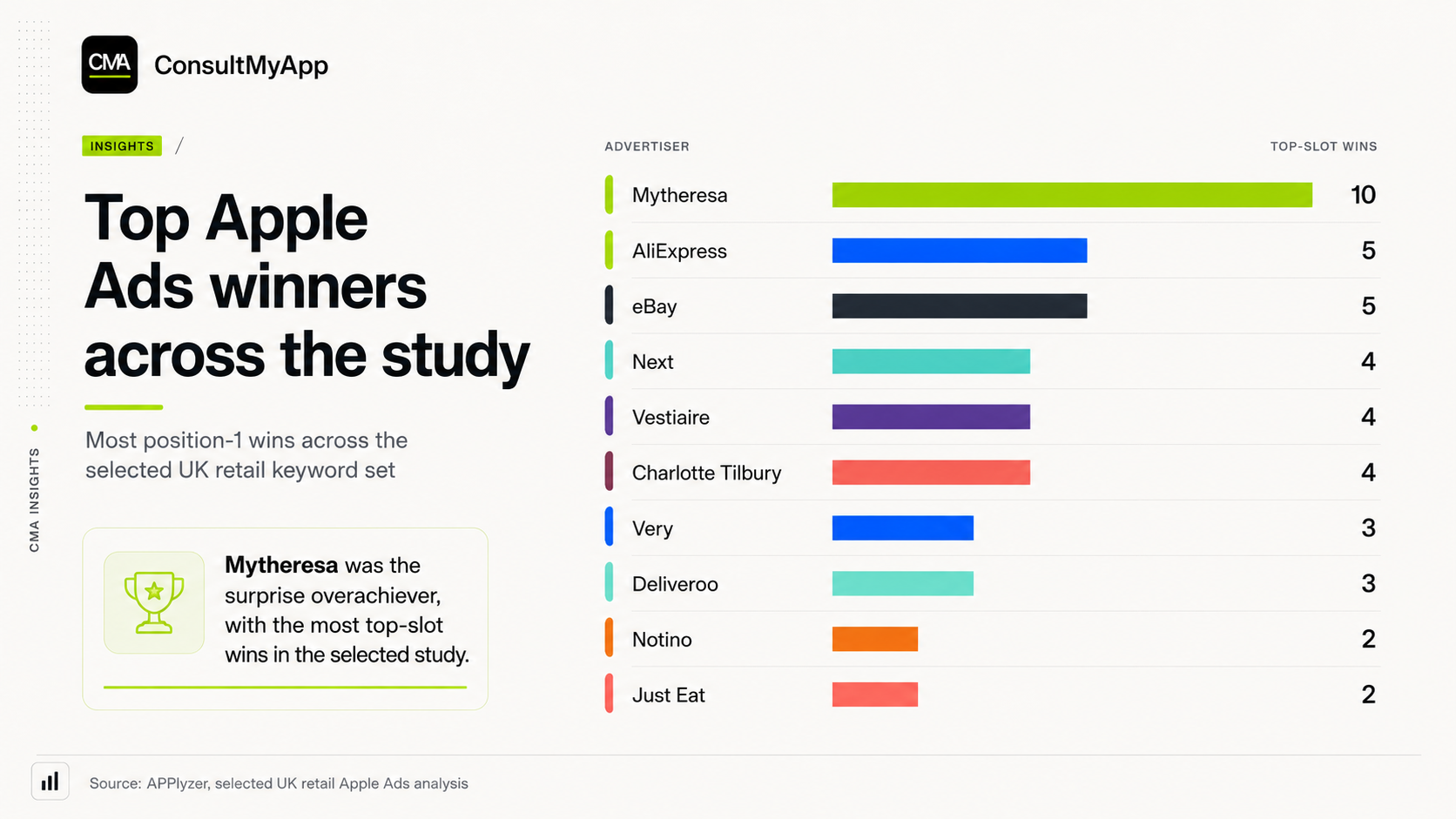
- Mytheresa over-performs in top-slot wins across the studied set.
- Resale is a mature paid-search battleground (Vestiaire, eBay, Vinted, etc.).
- Grocery is being gatecrashed by delivery apps.
- Home/DIY/electronics can be surprisingly noisy in App Store search.
1. Methodology
This study analysed a selected set of generic UK retail-intent search terms in the App Store using APPlyzer. The keyword universe intentionally avoided brand terms.
- Estimated daily search impressions
- Search score
- Apple Ads top placements (positions 1 to 5)
- Cluster-level winner and runner-up patterns
- Noise and relevance flags
2. The demand picture: “retail app” is the wrong fight
The most important demand insight is that retail language and shopper language are not the same thing. Users rarely search “retail app”. They search for the job they want done.
3. Broad shopping: AliExpress owns the front door
When UK users search broad shopping terms in the App Store, AliExpress is often the first paid result they see. These terms capture users who know they want to shop, but have not yet decided where.
4. Very: the full-funnel challenger
Very does not dominate by position-one wins. Its strength is breadth. It appears across broad shopping, fashion, footwear, furniture, beauty-adjacent terms, resale-adjacent terms, and generic retail searches.
Apple Ads success should not only be judged by position-one wins. Top-five consistency across many relevant searches can be strategically useful for multi-category retailers.
5. Mytheresa: the surprise overachiever
Mytheresa was expected to perform strongly on luxury terms. What stood out was its reach beyond luxury into broader fashion and value-led searches.
6. Fashion: fragmented, competitive and query-specific
Fashion does not have a single winner. Different retailers win different versions of fashion intent. Treat womenswear, menswear, dresses, jeans, luxury, sale-led shopping, and generic fashion searches as different auctions.
7. Resale and marketplace: one of the cleanest battlegrounds
The resale and marketplace cluster produced some of the clearest Apple Ads patterns in the study. Vestiaire was strong on second-hand and vintage clothing terms; eBay performed on broader marketplace and deals-led terms; Vinted was a strong challenger.
8. Grocery and food retail: supermarkets meet delivery apps
Grocery shows how category boundaries break down in the App Store. Supermarkets can win “cleaner” grocery-shopping terms, but delivery platforms dominate once the query shifts toward fulfilment.
A hungry user does not care whether the internal P&L calls it grocery, restaurant delivery, rapid commerce, or meal fulfilment. They want food to arrive.
9. Beauty: commercial queries work, broad queries get weird
Commercial beauty terms can be clean. Broader beauty terms can be noisy, and require careful validation before committing budget.
10. Home, furniture and DIY: useful in places, chaotic elsewhere
Home and DIY showed a big gap between category label and actual auction behaviour. Some obvious terms are polluted by non-retail intent.
11. Electronics: weaker than expected
App Store searches for electronics-related words often reflect app functionality rather than shopping intent. A user searching “camera” is often looking for a camera app, not a retailer selling cameras.
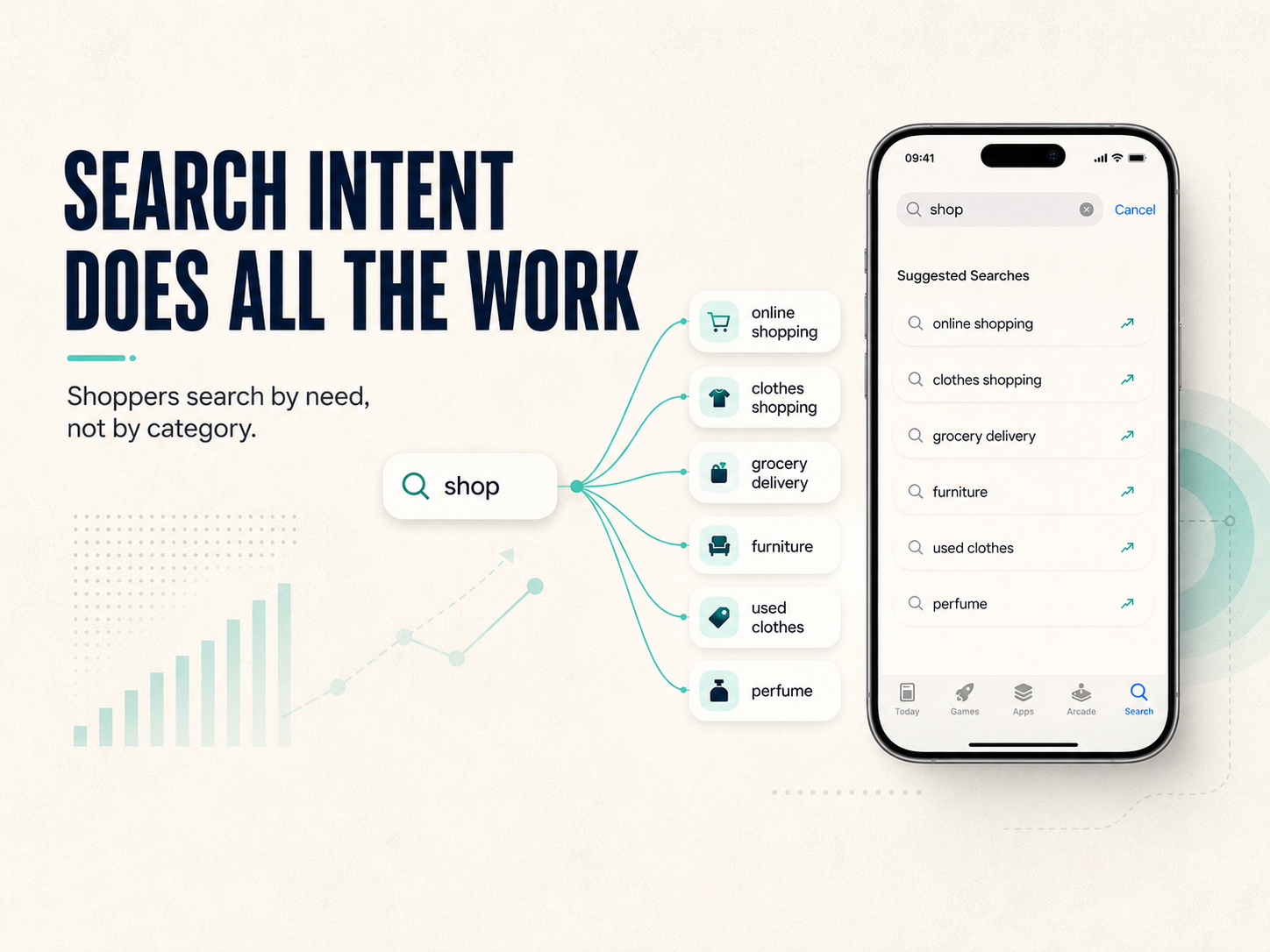
12. Search intent is doing all the work
Intent beats category. A useful Apple Ads keyword needs enough demand to matter, a clean enough auction to suggest commercial relevance, and a realistic competitive position.
13. Cluster-level view
The UK retail App Store can be summarised as a set of smaller intent battlegrounds.
14. Strategic recommendations for retail app marketers
14.1 Stop using internal language as keyword strategy
Base Apple Ads structure on how users search, not how teams label campaigns. Prioritise intent-led terms such as shop, shopping, online shopping, clothes shopping, grocery delivery, furniture, used clothes, perfume, deals.
14.2 Separate category intent from purchase intent
Validate auction composition before assuming relevance. Some keywords sound commercial but behave like functionality searches.
14.3 Build cluster-specific campaigns
Clustered campaign structure is supported by the data. It is the cleanest way to stop performance getting averaged into nonsense.
14.4 Monitor winners and runners-up
Position one matters, but top-five presence reveals competitive pressure and intent coverage.
14.5 Use noise flags in planning
Score keywords by volume and retail relevance. A simple framework: Clean, Mixed, Noisy. Noisy terms require proof before scaling.
15. Conclusion
The UK retail App Store is not one clean market. It is a collection of intent-led battlegrounds. Broad shopping, fashion, resale, grocery delivery, fragrance, and furniture show meaningful acquisition potential. Other terms can be misleading once you inspect the auction.
In Apple Ads, retail growth is not about buying keywords. It is about understanding intent before everyone else pays for the wrong one.
Want this operationalised?
If you want help turning this into an Apple Ads campaign structure and weekly monitoring workflow, we can help.